A lot of publishers and creators assume the next breakthrough will come from bigger reach. More sessions, more followers, more impressions, more top-of-funnel activity. But that is often the wrong first move. Deloitte Digital’s 2025 social commerce research found that 61% of consumers discovered a new brand or product on social media in the past 12 months, yet only 39% of social-first brands said social commerce was delivering high ROI. The opportunity is already there, but the monetization layer is often weak.

That is exactly where Shopday fits. Shopday’s publisher terms say the platform helps publishers monetize content through context-aware comparison tables and related placements based on user intent, available offers, and performance signals. Its homepage adds that Shopday uses AI to generate publisher placements based on content context, available offers, and performance signals. In other words, the goal is not just to get more traffic, it is to make the traffic you already have more valuable.

Why traffic growth is not always the first problem to solve
Traffic is expensive to earn and easy to waste. If a page gets attention but does not help people decide, more visitors just create more leakage. Deloitte’s research shows that 34% of consumers would be more likely to purchase on social platforms if the process were easier, and 46% say customer reviews make them more likely to buy. That points to a conversion problem, not just an audience problem.
The same pattern shows up in creator-led commerce. LTK’s 2025 creator report says 73% of Gen Z and 57% of Millennials rely on creators for purchase decisions, and 30% purchase after seeing a creator post a product once, rising to 40% after repeated posts. If people already trust recommendations, then the missing piece is usually not awareness. It is structure, clarity, and a better path from interest to action.
What better monetization strategy actually means
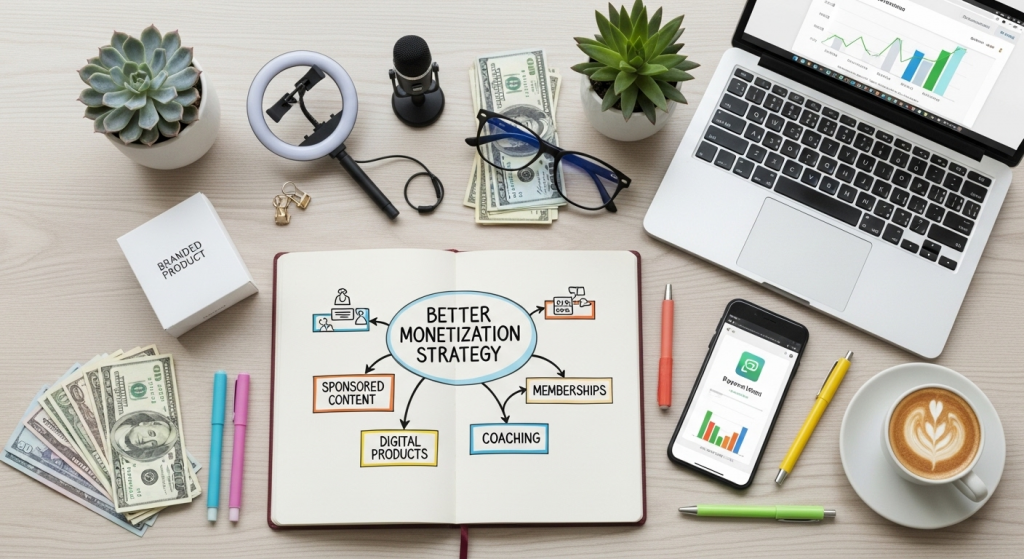
Better monetization strategy does not mean stuffing more links into your content. It means organizing existing traffic around decision moments. Shopday’s For Brands page says people do not discover brands randomly, they choose them while comparing options inside reviews, rankings, and buying guides. It also says Shopday inserts a smart comparison table with real buying options such as brands, retailers, or specific products, placing them directly among the options users are evaluating.
That is the real shift. Instead of treating every page like a traffic page, you start treating your best pages like decision pages. A traffic page says, “Thanks for visiting.” A monetized page says, “Here is how to choose.” Shopday is built for the second model.
The common mistake, chasing more visitors before fixing the leak
Many creators and publishers try to scale traffic before they understand where current visitors are dropping off. They publish more, promote more, and spend more time trying to widen the funnel. But if the monetization experience is weak, that growth does not compound very well. Deloitte’s data shows that even among social-first brands, revenue outcomes differ sharply depending on maturity: social-first brands report 14.4% of B2C revenue from social commerce versus 10.5% for low-maturity brands. Better systems produce better yield.
That is why the first optimization question should be simple: what happens after someone shows buying intent? If the answer is “they hit a generic homepage,” “they dig through a crowded link hub,” or “they have to figure it out themselves,” then traffic is not the first thing to fix. Shopday’s core model is designed to reduce exactly that friction by placing comparison units directly inside high-intent editorial environments.
Four places to optimize the traffic you already have

Find the pages with hidden commercial intent
Some of your most monetizable pages may not look like “money pages” yet. The strongest candidates are usually:
- best-of articles
- comparison posts
- alternatives content
- routines and setup pages
- review-style articles
- posts that attract “Where did you get that?” questions
Shopday’s For Brands page explicitly says high-intent content includes review and comparison articles like “best options,” “top picks,” and “brand alternatives.” Those are exactly the kinds of pages that should be monetized first.
Replace generic links with decision support
A weak monetization setup often sends qualified visitors into a dead end. A strong setup helps them compare. Shopday says it generates tables with real buying options and helps users choose with confidence, while publishers earn more from their content. That matters because recommendation pages tend to perform better when the click leads to clarity, not confusion.
In practical terms, this means replacing vague “shop here” behavior with pages that answer real questions:
- best overall
- best budget option
- best premium choice
- best alternative
- best for a specific use case
That is where comparison tables become much more than a design feature. They become the conversion engine inside the content itself.
Improve link placement, not just link volume
Adding more links does not automatically increase revenue. Often it just adds noise. Better monetization comes from placing commercial options where intent is highest, after the recommendation, inside the comparison moment, and near the point of decision. Shopday’s publisher terms and homepage both frame placements around content context, performance signals, and user intent, which is a much smarter model than blanket linking.
This is one reason Shopday works naturally inside editorial content. It is not asking publishers to turn every paragraph into a pitch. It is helping the monetization layer appear where it is most useful.
Track yield, not just volume
Once you stop obsessing over traffic alone, the next metric becomes yield: how much value are you generating from the visitors you already earned? Shopday’s publisher terms say reporting can include page URL, sub-ID, device, country, clicks, and revenue. That kind of visibility helps you see which pages deserve more optimization, which topics convert best, and where your current traffic is already closest to revenue.
This is where many teams change direction. They realize one high-intent comparison page can outperform several broad top-of-funnel posts. They also realize a smaller, more qualified audience can be more valuable than a larger, less decisive one. Deloitte’s data about ROI gaps in social commerce supports that exact idea.
What this looks like in practice
Imagine a creator or publisher with a post that already gets steady traffic: “Best carry-on bags for weekend trips.” The old monetization model might add one or two links and hope for the best. The better model would structure the page around decision-making, best overall, best for strict airlines, best budget pick, best premium pick, then let a Shopday comparison experience help readers evaluate options in one place. That keeps the user in a high-intent environment instead of sending them off with incomplete context.
Or take a page like “Best standing desks for small spaces.” You do not necessarily need more search traffic first. You may need better monetization architecture around the traffic you already have. Shopday’s homepage says it can turn content into a live comparison engine that updates itself, optimizes earnings, and delivers a better user experience. That is the kind of upgrade that raises revenue without requiring a bigger audience first.
What to fix first, before you chase more growth
Start with the pages that already show buying intent. Then ask four questions:
- Is the user trying to choose between options?
- Does the page help them compare clearly?
- Are links placed at the moment of decision?
- Can you measure what this page actually earns?
If the answer to any of those is no, your first priority is optimization, not expansion. Shopday’s own positioning is built around that premise, high-intent content performs better when it becomes a guided comparison experience instead of a passive article.
Why this strategy compounds

Traffic growth is often incremental and expensive. Better monetization strategy compounds because it improves the value of pages you already own. The stronger your recommendation structure, the better your click quality. The better your click quality, the easier it is to learn what converts. The easier it is to learn what converts, the more efficiently you can create future content. Shopday supports that cycle with intent-aware placements, dynamic updates, and more transparent performance signals.
That is also why this strategy tends to feel better editorially. You are not publishing more filler just to chase volume. You are making your best content more useful, more measurable, and more commercially effective. That is a much healthier long-term model for publishers and creators alike.
Conclusion: better monetization beats blind growth
You do not always need a bigger audience. Very often, you need a better system for the audience you already have.
If people are already landing on your pages, asking buying questions, reading comparisons, and looking for recommendations, then the opportunity is not hypothetical. It is already in front of you. What matters now is whether your content helps them act. Shopday is designed to close that gap, with AI-generated, context-aware comparison placements, smarter decision support, and clearer performance visibility built around real user intent.
So before you spend the next quarter chasing more traffic, fix the monetization strategy underneath the traffic you already earned. That is usually where the fastest gains are.
The responses below are not provided, commissioned, reviewed, approved, or otherwise endorsed by any financial entity or advertiser. It is not the advertiser’s responsibility to ensure all posts and/or questions are answered.